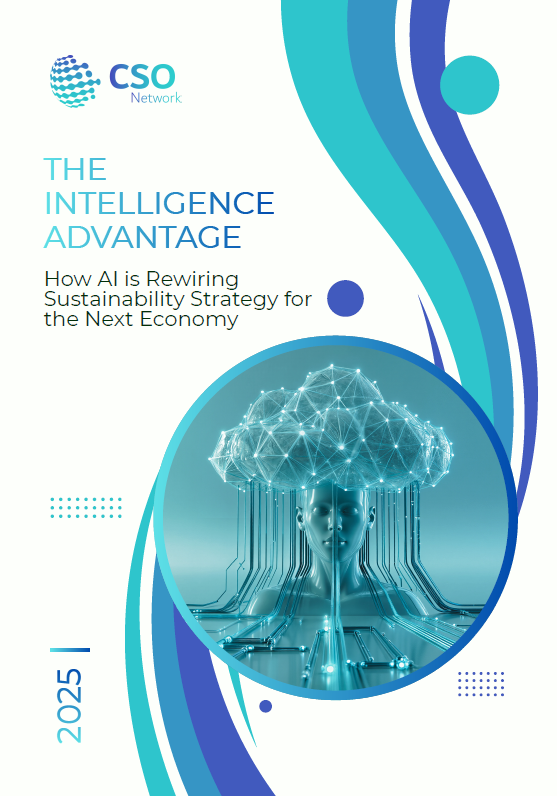
The Intelligence Advantage: How AI is Rewiring Sustainability Strategy for the Next Economy (2025) examines how AI and sustainability are converging—especially in the Middle East and Africa—to help institutions shift from reactive compliance to proactive, data-driven sustainability that improves resilience and competitiveness. It argues that AI is now a core enabler of sustainability transformation, with potential to reduce global emissions by 5–10% and unlock major regional economic value, while also addressing constraints like water scarcity.
What’s inside
AI + Sustainability as Competitive Advantage (MEA focus):
The whitepaper positions the Middle East and Africa as “leapfrog” markets that can adopt cutting-edge AI-enabled sustainability approaches without legacy constraints, and stresses the evolving role of sustainability leaders from compliance managers to strategic transformation leaders.
1) AI-powered systems transforming energy and infrastructure
It highlights AI-enabled smart grids and autonomous operations—citing examples like Dubai’s $1.9B smart grid initiative and Saudi Arabia’s plan to automate 40% of electricity distribution by 2025—and explains how AI supports predictive maintenance, load balancing, and renewable integration.
2) AI re-engineering corporate sustainability (“future-fit by design”)
The paper describes a shift toward “intelligent sustainability,” where AI enables real-time monitoring, predictive risk management, and sustainability embedded into core business decisions (not treated as a separate reporting exercise). It includes cases like ADNOC’s 2023 AI energy-saving efforts generating $500M value and reducing emissions by ~1M tonnes.
3) From forecasting to foresight
It argues AI enables earlier detection of signals, scenario modeling, and continuous adaptation—embedding sustainability foresight into strategy, risk, and planning rather than relying on backward-looking indicators.
4) Energy intelligence and the water–energy nexus
Beyond “energy management,” the whitepaper frames “energy intelligence” as AI-orchestrated coordination across distributed generation, storage, demand response, grid infrastructure, and (in water-scarce contexts) optimizing water use in power generation and desalination.